
Contract cleaning for airports and transport hubs, shopping centres, schools and universities, offices, kitchens, clinics, residential blocks and events — scoped, staffed and supervised.
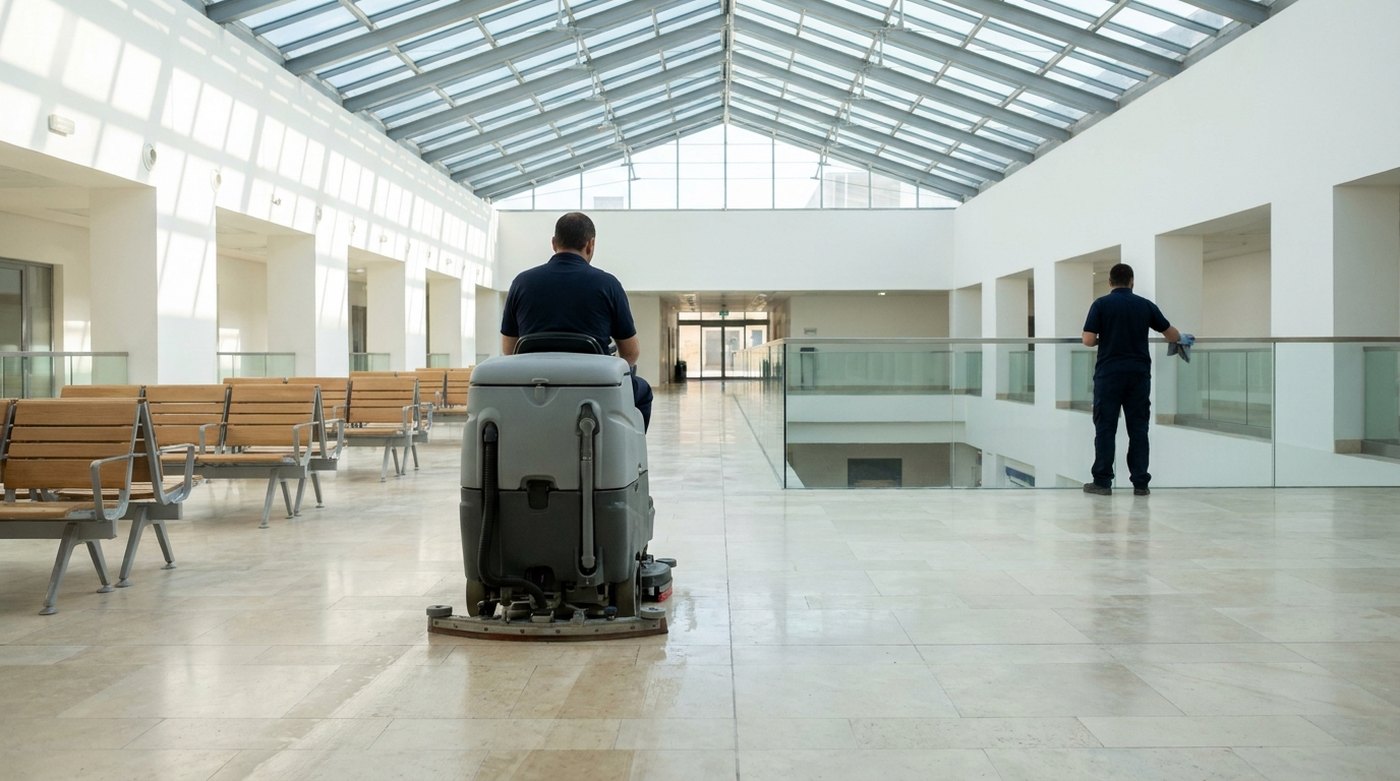
A building that never closes, thousands of people a day through its doors, a client who measures the clean against a written standard: that is contract cleaning, and it is a different business from sending a cleaner round. The work is planned in shifts and rotas, staffed with cover for absence, supervised on site, audited against agreed KPIs and documented in method statements and risk assessments before the first shift starts.
We put together contract proposals for organisations in Malta and Gozo — from a single office floor to multi-site estates — and match each contract to a specialist partner with the staff, equipment, insurance and clearances the site demands. You deal with us from the first survey to the start of the contract, and we stay your point of contact after it.
Every proposal starts with a site survey. We do not publish contract prices: the hours, the headcount, the shift pattern and the consumables decide the figure, and no two sites are alike.
A proper contract proposal answers six questions before it gives a price:
Cleaning companies in Malta employ their staff under the sector's own conditions of work, the Private Cleaning Services (Conditions of Work) Regulation Order, 2026 (L.N. 114 of 2026), in force since 30 June 2026. A contract price has to cover it.
Terminals, ferry and bus terminals run from the first departure to the last arrival, so the cleaning does too: continuous daytime cleaning of concourses, washrooms and seating, rapid response to spills, and overnight machine work on floors when footfall drops. Rotas, headcount and supervision are planned around the timetable, not office hours.
Airside work carries its own clearances. People working airside at Malta International Airport hold an airport security pass issued by Aviation Security Malta after a background check, under the Aviation Security (Background Checks) Regulations (L.N. 27 of 2014), and complete security awareness training. A proposal for airside cleaning has to show how every cleaner, including cover staff, will be cleared before they start.
Malls and retail parks need a visible daytime team on the floors, food court and washrooms during trading hours, and an overnight team for machine scrubbing, escalators, glass and high-level dust. Retail units, back-of-house corridors and service yards are scoped separately. A good contract sets response times for spills and washroom checks, because that is what shoppers notice first.
Education contracts are cleaned around the timetable: classrooms, corridors and washrooms after the school day, with a day cleaner for washrooms and spills, and the deep clean of the whole estate in the summer and holiday breaks. Universities add lecture halls, libraries, laboratories and residences, often across several buildings.
Working around children brings checks. Expect a school to ask for a police conduct certificate for each cleaner (issued through servizz.gov.mt) and to apply its own safeguarding requirements, with work involving minors governed by the Protection of Minors (Registration) Act (Cap. 518). The proposal states which checks every cleaner, including cover staff, carries.
Offices are usually cleaned out of hours to a written scope, with a day porter or day cleaner in larger buildings and business centres. Shared kitchens, meeting rooms and washrooms are the measure of a good contract; carpets, glass partitions and high-level dust are scheduled as periodic work. Smaller offices on a few visits a week are on our office cleaning page, priced per cleaner-hour.
Food businesses have a legal standard to clean to. EU food hygiene law, Regulation (EC) No 852/2004 (Annex II), which applies directly in Malta, requires food premises to be kept clean and in good repair, surfaces and equipment to be cleaned and where necessary disinfected, ventilation systems to be built so that filters and other parts needing cleaning are readily accessible, and adequate procedures to be in place to control pests.
A kitchen contract therefore covers more than floors: the nightly clean of cooking lines and food-contact surfaces, periodic deep cleans with equipment pulled out, and the canopy, filters and extraction that collect grease — grease in hoods and ducts is a fire risk as well as a hygiene one. Hotels add rooms, public areas, laundry and back-of-house. Pest control for food premises is usually a separate contract; see pest control on our sister site PestControl-Malta.
Clinics, dental practices, care homes and laboratories are cleaned to infection-control protocols set by the client: colour-coded equipment, set disinfectants and contact times, and documented frequencies. Disinfectants are biocidal products under EU law (Regulation (EU) No 528/2012) and must be authorised for the market; in Malta the competent authority is the Malta Competition and Consumer Affairs Authority. Clinical and other hazardous waste is not cleaning waste: it leaves under the Environment and Resources Authority's consignment procedure for hazardous waste, through registered carriers.
Stairs, lifts, entrances, garages, bin rooms and roofs, cleaned weekly or more often to a schedule the block's administrator agrees, with periodic window and glass cleaning and machine work on garage floors. A good common-parts contract leaves a log of every visit, so residents can see the work was done.
Events need cleaning in three phases: before the doors open, continuously during the event (washrooms, litter, spills), and the overnight or next-day clear-down. Staffing is planned around expected attendance and the venue's opening hours; outdoor events add litter picking and waste segregation. Event work is quoted per event after a look at the venue and the plan.
Send us the request below. We arrange a site survey, write the scope, and match the contract to a specialist partner with the right staff, insurance and clearances — then bring you one proposal with a named partner, a method statement and a price. If your contract is going out to tender, tell us the deadline: see cleaning tenders. For factories and warehouses see industrial cleaning; for disinfection, biohazard and trauma work see specialist cleaning; for glass and facades see window cleaning.
Contracts are not priced from a rate card: hours, headcount, shift pattern, consumables and clearances decide the figure, so every contract is quoted after a site survey. Small offices on a few visits a week can be priced per cleaner-hour.
| Job | Unit | Band | What is in it |
|---|---|---|---|
| Contract cleaning (any sector, multi-site, 24/7) | contract | quoted on site | quoted after a site survey |
| Office cleaning contract (monthly) | month | quoted on site | quoted after a walk-through |
| Office or commercial cleaning | per cleaner-hour | €19 | regular visits; a 3-hour or €80 minimum per visit is usual; contracts quoted after a walk-through |
| Window cleaning | job | quoted on site | quoted after a look at the windows — access decides it |
Per cleaner-hour · €19. Add other jobs in the full calculator →
For multi-site, out-of-hours or 24/7 cleaning, and specialist work. Tell us about the sites and the hours; we arrange a site survey and come back with one proposal, a named specialist partner and a price.
No contract prices are published: every contract is quoted after a site survey.
You deal with us. We quote free from a published rate card, choose a vetted company for the job — a CheckYourTraders member where there is one — and stay your point of contact throughout.
Contract cleaning for airports and transport hubs, shopping centres, schools and universities, offices, kitchens, clinics, residential blocks and events — scoped, staffed and supervised.
Request a contract proposal →It opens like an app, and the cost calculator works without a signal.