
What a cleaning contract SLA should contain
A clause-by-clause checklist for reading commercial cleaning proposals in Malta and Gozo — what the service-level agreement has to pin down before price means anything.
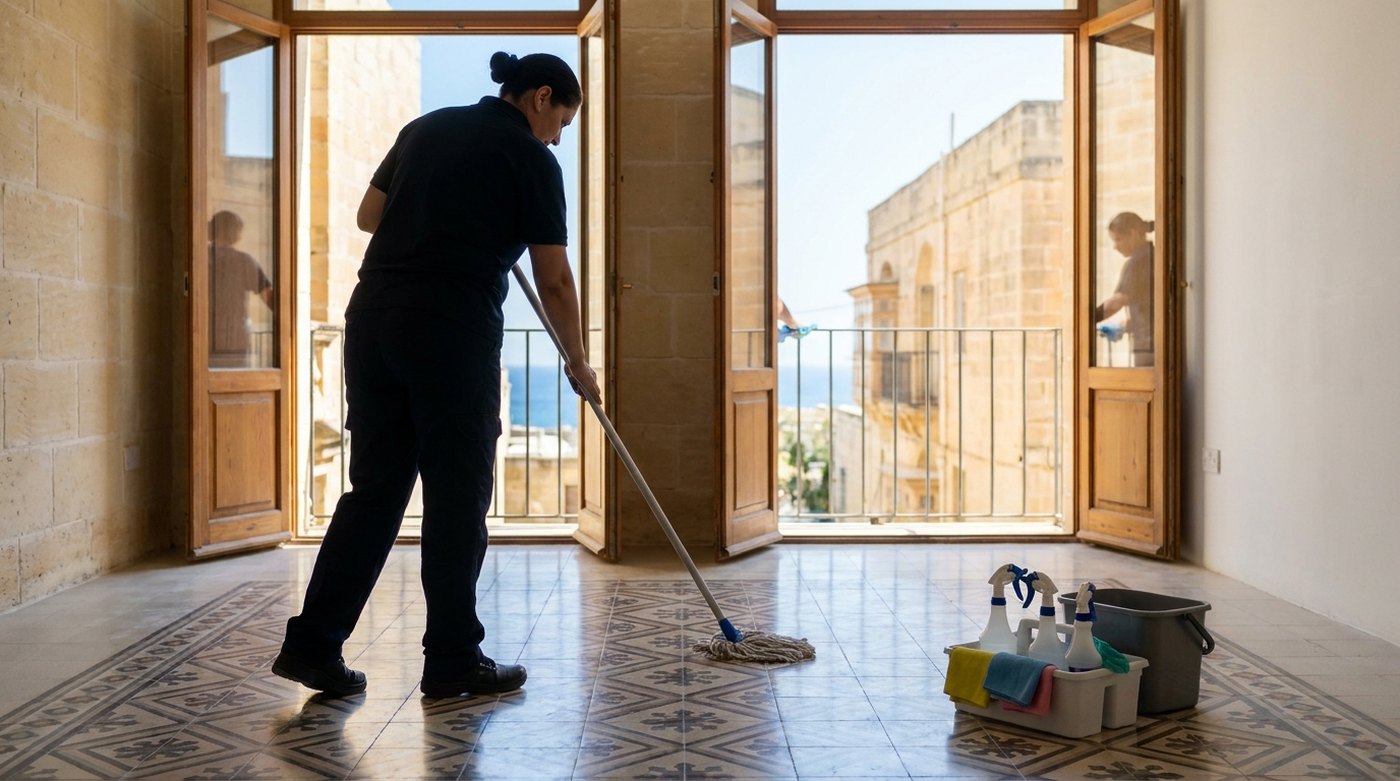
Commercial cleaning proposals in Malta are hard to compare because most of them are priced before they are specified. Two quotes for the same office can differ by a third simply because one assumes a single evening pass and the other assumes a daytime presence, or because one includes consumables and the other bills them on. The service-level agreement is where that ambiguity gets removed. Treat the following as a checklist to run against any proposal you receive for commercial cleaning before you compare prices.
Scope by area and frequency
The scope should be written area by area, not building by building. Reception, open-plan floors, meeting rooms, WCs, kitchens and tea points, lifts and lift lobbies, stairwells, server rooms, loading bays, external entrances. Each area gets a task list and a frequency: daily, three times weekly, weekly, monthly, quarterly, annual.
Separate the periodic work from the daily routine and give it dates. Hard-floor stripping and sealing, carpet extraction, high-level dusting, internal glass and window cleaning, upholstery — these should appear as scheduled line items with a month against them, not as a sentence saying "as required". "As required" always means "when someone complains".
In an apartment block or a mixed-use building, say explicitly where the demise ends. Condominium rules govern the common parts, and the condominium — not your tenancy — may control who cleans the stairwell, the roof access and the façade. Get that boundary into the scope or you will pay twice for the landing outside your door.
Hours, shift pattern and staffing
The SLA should state the daily attendance window, the number of cleaner-hours per visit, and whether the pattern is pre-occupancy, out-of-hours or a daytime presence. Add the number of operatives, because four hours delivered by one person at 6am is a different service from four hours delivered by two people at 5pm.
Then deal with absence. Who covers sickness and leave, within what notice, and does cover arrive at the same skill level? Absence cover is the single clause that most often separates a proposal that works from one that collapses in August.
Supervision, KPIs and audits
Name the supervision model: a working supervisor on site, a mobile area supervisor, or periodic management visits. Say how often each happens.
KPIs need three things to be real — a measurable standard, a scoring method, and an inspection frequency. Agree the audit sheet before the contract starts: which areas are sampled, how many points each element carries, what score counts as a pass, and whether your facilities team scores jointly with the contractor or separately. No Maltese body publishes a standard cleaning audit score, so whatever you agree is the standard.
Reactive work and response times
Spillages, blocked WCs, post-event clear-downs and water ingress need a defined response: a contact route, an acknowledgement time and an attendance time, split between working hours and out-of-hours. If the site is in Gozo, write the response time with the ferry in it. Every operative, machine and pallet of consumables that is not already on the island arrives by crossing, and an SLA that promises a two-hour mainland response for a Gozo site is a clause nobody can honour.
Consumables, equipment and waste
State who supplies and who stocks hand towels, toilet tissue, soap, bin liners and sanitary units, and whether they are in the rate or billed separately. Then state the replenishment trigger — par levels, not goodwill.
Equipment: who owns the machines, who maintains them, who pays for power and water, and where the cleaners' store and sluice are. Waste: name the route. Who takes bags to the bin store, who presents bins for collection, who deals with recycling streams and confidential waste, and who is responsible when the bin store is full.
Documentation you should ask to see
- Method statements for each periodic task, especially anything involving working at height or wet floors in public areas.
- Risk assessments for the site, reviewed when the layout or occupancy changes.
- Safety data sheets for every chemical brought on site, held in the cleaners' store and available to your health and safety officer.
- Evidence of insurance cover, with the policy limits and the renewal date, not just a confirmation that cover exists.
Clearances and site-specific obligations
Some sites restrict who may enter. Airside work is governed by aviation security background checks, with airport security passes issued by Aviation Security Malta (AVSEC) under L.N. 27 of 2014; if your site needs them, the SLA should say who applies, who pays and what happens to cover while a pass is pending. Read the regulations before you set a timetable, as the lead times are not published in a form you can plan against.
For schools and similar settings, buyers routinely ask for police conduct certificates for every operative and for the SLA to require re-checking on rotation. That is a contract term to agree and verify — not something these sources establish as a legal duty.
Where the contract touches a kitchen that is a food business, Regulation (EC) No 852/2004 Annex II requires premises to be kept clean, surfaces and equipment to be cleaned and where necessary disinfected, ventilation filters to be accessible for cleaning, and adequate pest-control procedures. Annex II does not tell you how often. Split the duties in writing between your catering team and the cleaning contractor, and have the schedule signed.
The price has to carry the sector conditions
From 30 June 2026 the Private Cleaning Services (Conditions of Work) Regulation Order, 2026 (L.N. 114 of 2026) sets minimum conditions for the sector covering hours, overtime, uniforms and PPE free of charge, and sick leave. Those are costs, and they sit inside the hourly rate. When you compare tenders, the cheapest number on the page is sometimes the one that has not priced them. Ask each bidder to confirm in writing that the rate covers the order, and treat an unexplained gap between bids as a question rather than a saving.
Remedies, review and exit
Monthly or quarterly review meetings, with the audit scores and the reactive log as standing items, and minutes. A remedy ladder for missed KPIs — rectification within a stated period, then re-performance at the contractor's cost, then a service credit, then termination for repeated failure. Vague "the contractor shall use best endeavours" wording gives you nothing to act on.
At the end: notice period both ways, return of keys, fobs and passes, removal of equipment and chemicals, a final condition inspection, and handover of audit records and safety data sheets. Staff transfer is the clause to raise early — these sources do not establish what happens to incumbent cleaners when a Maltese contract changes hands, so settle it before the tender closes rather than in the last fortnight.
We quote the work and pass it to a company we have vetted for that type of site — a CheckYourTraders member where there is one, or a specialist partner for commercial, contract and specialist work. You deal with us throughout, including scope changes and audit disputes.
Common questions
- What is the difference between the scope of works and the SLA?
- The scope of works lists what gets cleaned and how often, area by area. The SLA sets the standard the work has to reach, how that standard is measured and scored, how quickly reactive calls are answered, and what happens when a target is missed. A proposal with a scope but no measurement and no remedy is a price list, not an agreement.
- Does a cleaning contractor working in our staff kitchen need anything special?
- If the area is a food business, Regulation (EC) No 852/2004 Annex II applies to the premises: they must be kept clean, surfaces and equipment cleaned and where necessary disinfected, ventilation filters kept accessible for cleaning, and adequate pest-control procedures in place. The SLA should say which of those duties sit with the cleaning contractor and which stay with your catering team, and should record who signs the cleaning schedule.
- Will the Private Cleaning Services order change what we pay from mid-2026?
- The Private Cleaning Services (Conditions of Work) Regulation Order, 2026 (L.N. 114 of 2026) is in force from 30 June 2026 and sets sector minimum conditions covering hours, overtime, uniforms and PPE free of charge, and sick leave. Those conditions are a cost in the hourly rate. A tender priced below the cost of meeting them is not a cheaper contract, it is an undeliverable one.
- Who handles the contract if the work is passed to another company?
- We quote the job and pass it to a company we have vetted for that type of work — a CheckYourTraders member where there is one, or a specialist partner for commercial, contract and specialist work. You deal with us throughout: scope changes, audit disputes and reactive calls come back through us.
What we could not establish
- The sources do not establish any police conduct certificate requirement for contractors working in Maltese schools, nor who must hold or renew one. Treat it as a contract term to agree and verify, not as a settled legal duty.
- No cleaning-specific business licence for cleaning contractors in Malta was found in these sources.
- Regulation (EC) No 852/2004 Annex II sets outcomes — clean premises, cleaned and where necessary disinfected surfaces — but prescribes no cleaning frequencies, products or audit scores. Any frequency in an SLA is a commercial decision, not a legal minimum.
- The sources do not establish what happens to incumbent cleaning staff when a Maltese contract changes hands. If staff transfer matters to you, take your own advice before the tender closes.
- L.N. 27 of 2014 concerns aviation security background checks and airport passes issued by Aviation Security Malta (AVSEC); the sources do not set out lead times or the application process. Read the text before relying on any timetable.
- No published Maltese benchmark exists for cleaning audit scoring — pass marks, weighting and inspection frequency are negotiated, not standard.
Sources
- Regulation (EC) No 852/2004 on the hygiene of foodstuffs — EUR-Lex · read 2026-10-29
- Aviation Security (Background Checks) (Amendment) Regulations, 2014 (L.N. 27 of 2014) — legislation.mt · read 2026-10-29
- Private Cleaning Services (Conditions of Work) Regulation Order, 2026 (L.N. 114 of 2026) — legislation.mt · read 2026-10-29
Drafted with Claude — claude-opus-5, then read, corrected and approved by Neil Bennett before publication. We do not publish anything a person has not read.
Want this costed properly?
The calculator gives you a figure in a minute. A site visit gives you a fixed price.
Book a free survey