
After-builders cleaning in Malta: why dust needs more
A builders' sweep-up is not a clean. Fine limestone and plaster dust keeps settling for days, needs damp methods and filtered vacuums, and usually takes two cleaners half a day or more at €16–20 per cleaner-hour, VAT included.
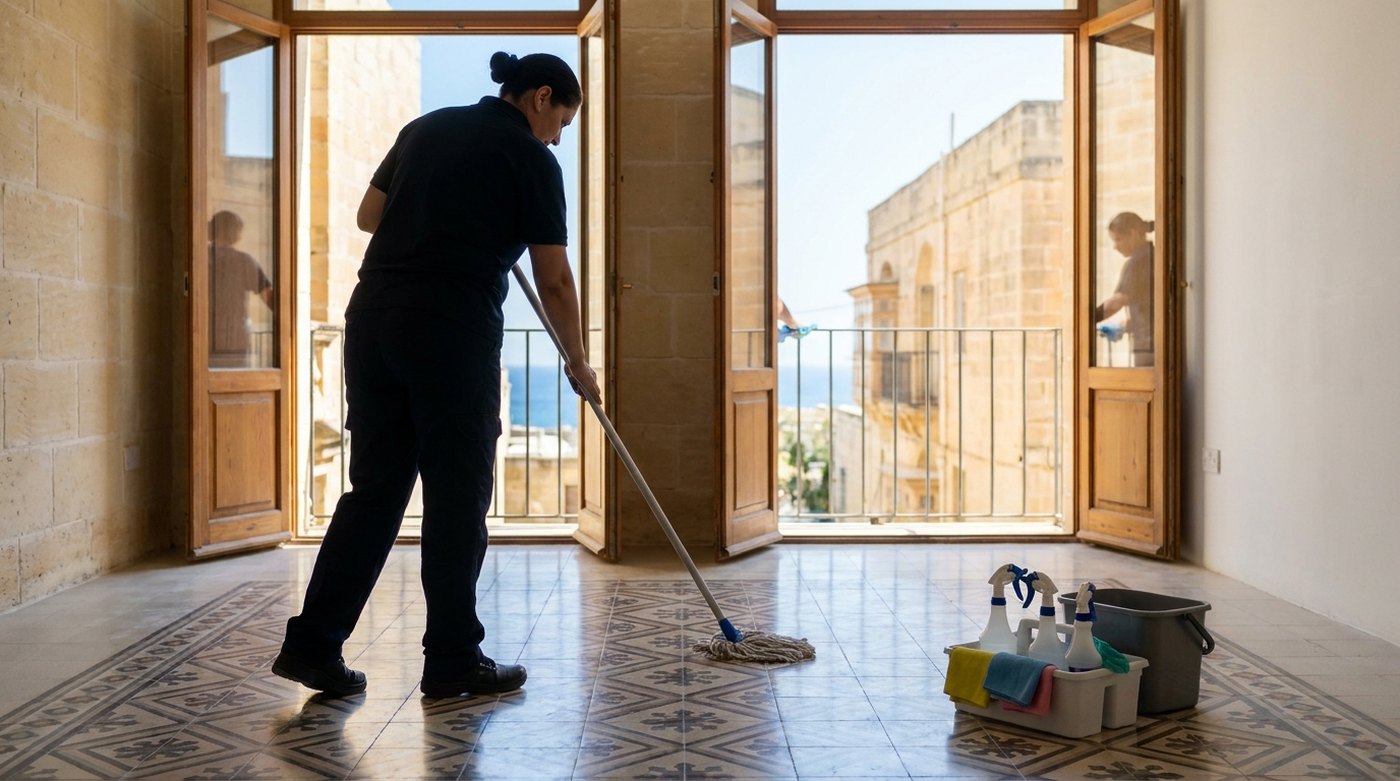
Renovation finishes the way it always does. The last trade packs up, someone runs a broom over the floor, the skip goes, and the property looks finished until the light changes in the afternoon and you see a grey film on every horizontal surface you thought was clean. Two days later it is back. That is the point at which most people in Malta start looking for after-builders cleaning, and it is worth understanding what they are actually buying.
A sweep-up is not a clean
Most building contracts include site clearance: the contractor removes rubble, offcuts, broken tiles, cement bags, packaging and the general debris of the works. That is the contractor's waste and it stays the contractor's responsibility. It is not something a cleaning company carts away, and a cleaning quote does not include skip hire or waste permits.
What is left after clearance is a different problem. Fine dust has migrated into every cupboard, drawer runner, hinge, shutter box, curtain pocket, light fitting and air-conditioning grille in the property. Paint has spotted tiles and glass. Tile adhesive and grout haze have left a dull film that looks like dirt but is a mineral deposit. Protective film is still on window frames, shower screens, worktops, sanitaryware and sometimes on the inside of new appliances, and the adhesive has started to bake on if the works ran through the summer. Sawdust is inside the new kitchen carcasses, not on them. Silicone smears, plaster splashes, drill dust in sockets, cement feet on thresholds.
None of that responds to a broom and a bucket.
Why dry sweeping and blowing are the wrong methods
The limestone most Maltese buildings are cut from, along with plaster, screed, tile backing and mortar, produces a dust that is very fine and very light. Sweep it and most of it goes airborne; blow it with a compressor and all of it does. It then settles over the following days on everything that was just cleaned, which is why a cheap sweep-up feels like it did nothing a week later.
There is a health reason as well as a practical one. Under Directive (EU) 2017/2398, work involving exposure to respirable crystalline silica dust generated by a work process was added to the EU's carcinogens and mutagens directive, with an occupational exposure limit. In plain terms: the fine fraction of construction dust is a recognised workplace hazard, not just a nuisance. That is an argument for damp methods, filtered industrial vacuums and masks, and against dry brushing and blowers.
OHSA is Malta's occupational health and safety regulator under Cap. 424. We found no Maltese guidance from OHSA specific to post-works cleaning when we checked on 29 October 2026, so nothing in the method below is attributed to them — it is standard practice, not a published rule.
What good practice looks like on site:
- Vacuum first, with an industrial machine and filtration, working top down: ceilings, coving, ducting, door tops, shelves, then floors.
- Damp wiping rather than dry dusting, with cloths rinsed or changed often so dust is removed rather than redistributed.
- Cupboards and drawers cleaned inside, not just fronts wiped.
- Protective film peeled and adhesive residue removed with a solvent appropriate to the surface.
- Paint spots and grout haze taken off with scrapers and the correct chemistry — the wrong acid on polished stone or a blade on a coated frame does damage that costs more than the clean.
- A second pass over floors after everything above them has been done, because the first floor wash collects what the high-level work brings down.
Timing: after the last trade, usually two passes
Book the clean after the last trade, not between trades. If the carpenter is still returning to hang doors or the painter has a snag list, their work will undo a finished clean.
In practice renovations rarely end tidily, so many jobs are planned as two passes: a rough pass once the heavy work stops — which lets the next trades work in a usable space and gets the bulk of the dust out of the building — and a final pass after the last snag is closed, before furniture arrives or the property goes on the market. Two passes cost more than one. They also tend to be the only way to get a genuinely finished result, because dust that is still coming out of cupboards and shutter boxes on day one will not be gone by lunchtime.
A few Malta-specific scheduling points. Shell form is the normal way property is sold here, so a first finishing-out is a full construction clean rather than a touch-up. In apartments, condominium rules govern lift use, common-part protection and working hours, and they apply to the cleaning crew as much as to the builders — common stairs and landings dirtied by the works are usually a separate conversation with the condominium. In Gozo, every delivery and every crew movement involves a ferry crossing, which affects start times and minimum job sizes.
What it costs
Published Maltese prices for after-builders work run €16–20 per cleaner-hour, VAT included. It sits above regular cleaning (€13–19 per cleaner-hour, usually with a three-hour minimum) and above deep cleaning (€15–18 per cleaner-hour) because of the consumables, the machines, the waste it generates and the slow, repetitive nature of the work.
Jobs are normally staffed with two cleaners for half a day or more. One person working alone cannot stay ahead of resettling dust in a property of any size, and the high-level work needs someone below finishing floors afterwards.
Some items are quoted separately rather than carried on an hourly band: window cleaning, oven cleaning, carpet and upholstery cleaning, and external pressure washing are all priced per job. If your finished property also needs upholstery cleaned, published Maltese prices for a two-seater sofa run €53–70 and a three-seater €71–85, with mattresses at €35–45 single and €65–71 double.
How we handle it
We quote the job ourselves after establishing the size, the state of the property and whether one pass or two is realistic. The work is then passed to a vetted company we choose for that job — a CheckYourTraders member where there is one for the work in question, or a specialist partner where the job calls for it. You deal with us throughout, including if something needs to go back.
Two things worth knowing before you compare quotes. We found no cleaning-specific business licence in Malta, so a claim of being "licensed" does not distinguish one cleaning company from another. And since 30 June 2026 the sector has been covered by the Private Cleaning Services (Conditions of Work) Regulation Order, 2026 (L.N. 114 of 2026); cleaners employed directly by a household fall instead under the Domestic Service (Conditions of Work) Regulation Order, 2026 (L.N. 142 of 2026). Those orders set conditions of work, not prices, and we are not in a position to give legal advice on them.
More detail on scope is on our post-construction cleaning page. If the renovation itself is still to be done, our sister site Turnkey.mt handles that side.
Common questions
- Isn't the builder supposed to clean up at the end?
- Most contracts include a sweep-up and the removal of the contractor's own waste — rubble, offcuts, packaging, bags of hardened mortar. That is site clearance, not cleaning. Removing building waste is the contractor's job and stays with the contractor; an after-builders clean deals with dust, residues, film, paint spots and grout haze once the waste is gone.
- When should the after-builders clean be booked?
- After the last trade has finished, not between trades. If electricians, carpenters or painters are still coming back, their work will put dust and marks on surfaces that have already been cleaned. In practice many renovations need two passes: a rough pass once the heavy work stops, and a final pass after the last snag has been fixed.
- Why can't the cleaners just sweep and then mop?
- Dry sweeping and blowing put the finest particles back into the air, where they settle again for days and get drawn into air-conditioning units. Construction dust also contains respirable crystalline silica, which EU law treats as a workplace carcinogen when it is generated by a work process. Damp methods, filtered industrial vacuums and repeated passes keep the dust in the cloth or the machine instead of in the air.
- What does after-builders cleaning cost in Malta?
- Published Maltese prices for after-builders work run €16–20 per cleaner-hour, VAT included. It is normally priced with two cleaners for half a day or more, because one person working alone cannot keep ahead of dust that is still settling. We quote the job before anyone is booked.
What we could not establish
- OHSA publishes no Maltese guidance specific to post-construction or after-builders cleaning that we could find on 29 October 2026, so no cleaning method in this article is attributed to the regulator.
- Nobody publishes a Maltese standard for what an 'after-builders clean' must include, so scopes vary between companies and must be agreed in writing before the job.
- There is no published figure for how long fine dust keeps resettling after a renovation; it depends on the works, the ventilation and whether neighbouring units are still under construction.
- Window cleaning, oven cleaning, carpet and upholstery cleaning and external pressure washing are quoted per job rather than carried on a published hourly rate.
- We found no cleaning-specific business licence in Malta, so 'licensed' is not a meaningful filter when choosing a company for this work.
Sources
- Directive (EU) 2017/2398 amending Directive 2004/37/EC (carcinogens and mutagens at work) — respirable crystalline silica dust — EUR-Lex · read 2026-10-29
- Occupational Health and Safety Authority — OHSA Malta · read 2026-10-29
Drafted with Claude — claude-opus-5, then read, corrected and approved by Neil Bennett before publication. We do not publish anything a person has not read.
Want this costed properly?
The calculator gives you a figure in a minute. A site visit gives you a fixed price.
Book a free survey